
In 2013, artist KC Green published a six-panel webcomic titled “On Fire.” A cartoon dog sits in a room engulfed in flames, coffee cup in hand, murmuring “This is fine” as the inferno consumes everything around him. The strip became one of the internet’s most durable memes—shorthand for wilful denial in the face of obvious catastrophe.
New Zealand’s electricity system brings the dog to mind.
On paper, the country operates one of the greenest grids on Earth. Roughly 87% of generation came from renewable sources in 2023, according to the Ministry of Business, Innovation and Employment (MBIE). Politicians routinely cite this figure as proof of climate leadership. The reality is more precarious. New Zealand has built its power system around the assumption that rain will fall, rivers will flow, and hydro dams will deliver. When those assumptions fail—and they do, with increasing frequency—the dog’s calm reassurance starts to look less like confidence and more like cope.
The Hydro Dependency
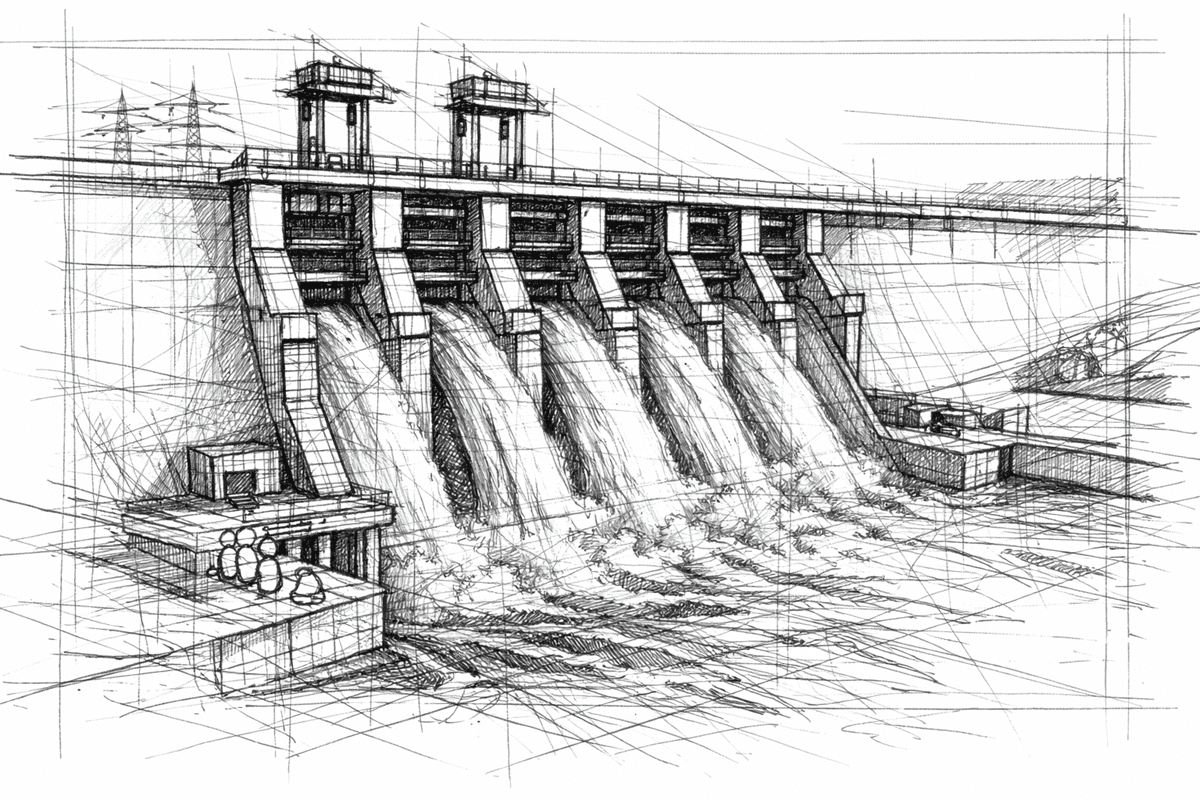
New Zealand’s electricity mix is dominated by a single technology to a degree unusual among developed economies.
In 2023, the breakdown looked roughly like this:
- Hydro: 60%
- Geothermal: 18%
- Wind: 7%
- Gas: 8%
- Coal: 2%
- Solar and other: 5%
That hydro figure isn’t just high—it’s structurally embedded. The country’s major dams, concentrated in the South Island’s Waitaki and Clutha catchments, were built between the 1930s and 1980s. They provide cheap baseload power when lakes are full. But hydro is not battery storage. It depends on snowmelt and rainfall patterns that vary dramatically from year to year.
The Electricity Authority tracks “hydro risk”—the probability that reservoir levels fall low enough to threaten supply. In a normal year, the system carries comfortable margins. In a dry year, those margins evaporate.
When the Rain Doesn’t Come
The 2021 dry year crisis revealed how thin New Zealand’s buffer really is.
Lake levels in the South Island fell to historic lows. Inflows to major catchments dropped to 70% of average. Wholesale electricity prices spiked to over NZ$300 per megawatt-hour—roughly triple normal levels. The grid operator issued conservation appeals. Genesis Energy, one of the country’s largest generators, restarted its coal units at Huntly Power Station—plant that was supposed to be phased out.
The immediate crisis passed when autumn rains arrived. But the episode exposed several uncomfortable truths:
- New Zealand has no strategic energy reserve. Unlike countries with gas storage or oil stockpiles, the electricity system operates on a just-in-time basis.
- Thermal backup is shrinking. Gas fields are depleting, and no new investment is flowing into fossil generation that faces an uncertain regulatory future.
- Climate change is loading the dice. NIWA, the national weather service, projects more variability in precipitation patterns—wetter wets, drier dries.
The government’s response was to commission yet another review. The dog sipped his coffee.
The Tiwai Wildcard
Any discussion of New Zealand electricity must reckon with a single, peculiar fact: one aluminium smelter consumes roughly 13% of national generation.
Rio Tinto’s Tiwai Point facility, located at the southern tip of the South Island, has operated since 1971. It exists because of a sweetheart deal—long-term contracts that locked in electricity prices well below market rates. The smelter employs around 1,000 workers directly and supports the economy of Southland.
It also distorts everything.
For years, Rio Tinto has threatened closure, using the prospect as leverage for better terms. In 2024, the company announced it would wind down operations by December 2028. If that happens, approximately 5 terawatt-hours of annual demand—equivalent to powering 600,000 homes—suddenly disappears from the system.
The implications cut multiple ways:
- Surplus generation: The South Island would have far more hydro capacity than it needs, potentially enabling electrification elsewhere.
- Stranded transmission: The HVDC link connecting the islands was sized partly around Tiwai’s demand.
- Price disruption: Wholesale markets would need to find a new equilibrium.
Some analysts see Tiwai’s closure as an opportunity—a chance to redirect cheap renewable power toward data centres, green hydrogen, or industrial heat. Others worry about the regional economic shock and the loss of a major baseload customer that helps stabilise the grid.
The Transmission Constraint
New Zealand’s geography creates an obvious problem. The South Island generates most of the hydro. The North Island contains most of the people.
The solution, built in stages from 1965 onward, is the High Voltage Direct Current (HVDC) Inter-Island Link—undersea cables running beneath Cook Strait. The link can transfer up to 1,200 megawatts in either direction.
But 1,200 megawatts is not enough.
During dry years, when the South Island needs to import power from North Island gas plants, the cable runs at or near capacity. During wet years, surplus hydro gets bottled up because the link can’t carry it all north. Transpower, the grid operator, has studied upgrades for years. The projected cost: several billion dollars. The projected timeline: a decade or more.
Until then, New Zealand operates two semi-connected electricity markets rather than one integrated system.
The Policy Paralysis
New Zealand’s energy debate is stuck in a familiar loop.
The problem is well understood. The country needs more generation, more storage, and more transmission to maintain reliability while decarbonising. The solutions are technically feasible: wind farms, utility-scale batteries, pumped hydro, demand response, possibly a second HVDC link.
What’s missing is a coherent plan for getting there.
The previous Labour government set a target of 100% renewable electricity by 2030. The current National-led coalition has softened that goal, emphasising “affordability” and “reliability” while remaining vague on how to achieve either. Meanwhile:
- Wind development is accelerating, but consenting and grid connection remain slow.
- Battery storage is nascent, with only a handful of utility-scale projects under construction.
- Pumped hydro at Lake Onslow—a massive South Island project that could provide weeks of backup storage—was studied extensively, then quietly shelved as too expensive.
- Gas policy is incoherent: The government wants to keep thermal backup available but won’t permit new gas exploration, ensuring existing fields deplete.
The result is a system that depends on weather cooperating and assets not failing. When everything aligns, New Zealand’s grid is clean, cheap, and reliable. When it doesn’t, the dog sits surrounded by flames.
How Others Manage
New Zealand is not the only hydro-dependent system facing these challenges.
Norway generates over 90% of its electricity from hydro and has experienced similar dry-year volatility. Its solution: deep integration with European markets via undersea cables to Denmark, Germany, the Netherlands, and Britain. When Norwegian reservoirs run low, electrons flow in. When they’re full, Norway exports. The interconnection provides insurance that geography denies New Zealand.
Tasmania, Australia’s island state, faces a closer analogue. It runs roughly 90% renewable, mostly hydro, with a single cable (Basslink) connecting it to the mainland. Tasmania has experienced its own dry-year crises—most severely in 2015-16, when low dam levels and a Basslink outage forced diesel generation and industrial shutdowns. The response included commissioning a second interconnector and investing in battery storage.
The lesson from both cases: hydro-heavy systems need either robust interconnection or substantial backup capacity. Hoping for average rainfall is not a strategy.
The Path Forward
New Zealand’s electricity future will be shaped by a few key decisions made—or avoided—over the next several years.
If Tiwai closes as planned, the country gains a window to reconfigure its system. The freed-up hydro capacity could support electrification of transport and industrial heat, attract new industries, or simply lower prices. But capturing that value requires transmission upgrades and policy clarity that don’t currently exist.
If another severe dry year hits before backup capacity is built, New Zealand faces a genuine supply emergency. The coal units at Huntly are reaching end-of-life. Gas supply is depleting. The margin for error is shrinking.
If policymakers choose to invest seriously in resilience—whether through pumped hydro, batteries, demand response, or a combination—the costs will be substantial but manageable. The Interim Climate Change Committee estimated in 2019 that an electricity system transition would require NZ$14-21 billion in new generation investment by 2035. Spread over the economy, that’s roughly 1-2% of GDP.
The question is whether voters and politicians are willing to pay for insurance against a risk that feels abstract until it arrives.
Conclusion
New Zealand’s electricity system is a remarkable achievement—one of the cleanest grids in the developed world, built on a foundation of mid-century hydro engineering and volcanic geology. It deserves the praise it receives.
But clean is not the same as resilient. The country has optimised for average conditions while underinvesting in the margins. Each dry year brings warnings; each recovery brings complacency. The structural risks—climate variability, transmission constraints, depleting gas backup, Tiwai uncertainty—are not secrets. They appear in official reports, academic studies, and industry submissions. They simply haven’t translated into action.
The dog remains seated. The room remains on fire. And somewhere in Wellington, a policy review is surely underway.
Leave a Reply