
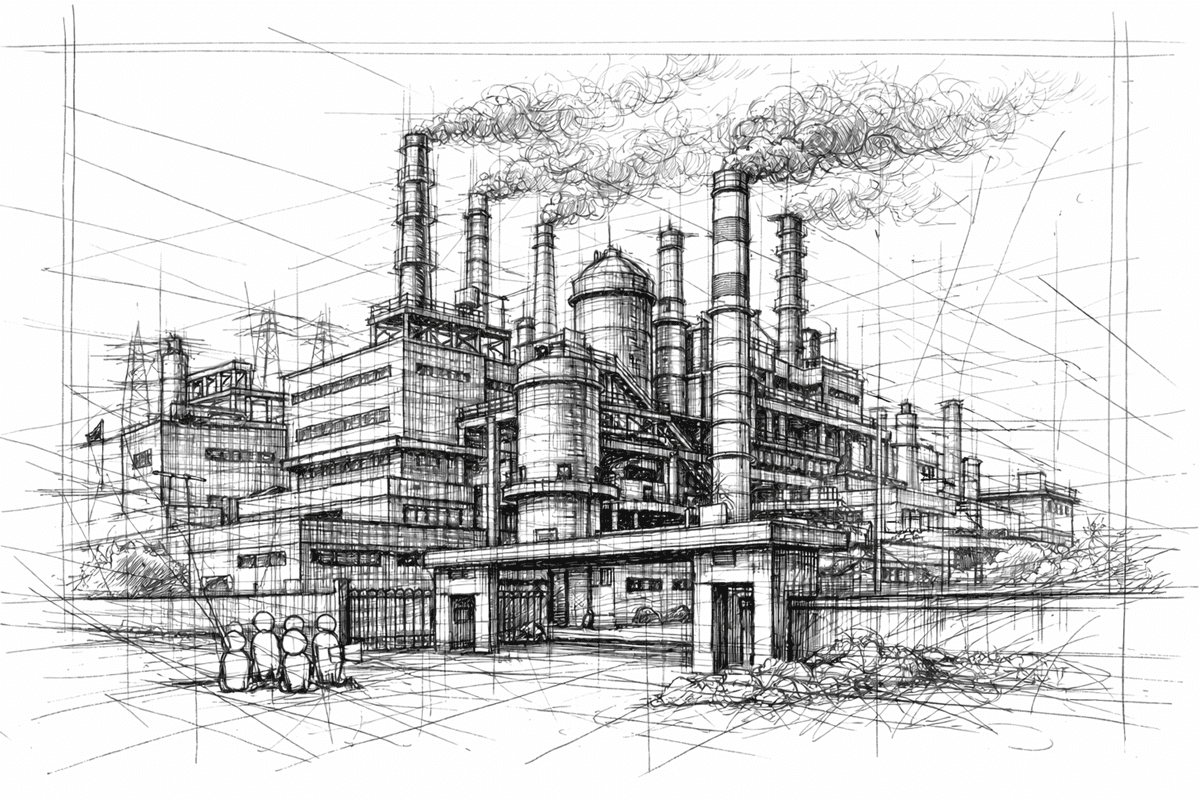
In Factorio, the cult factory-building game that has consumed millions of hours from engineers and optimisation addicts, players quickly learn a counterintuitive lesson: the solution to inefficiency isn’t optimisation—it’s scale.
When your iron smelting array can’t keep up with demand, you don’t fine-tune the existing setup. You build another one. Then another. You sprawl across the map with redundant production lines, accept the wasted resources, and trust that throughput solves problems that elegance cannot.
The game’s community has a saying, repeated with something between irony and reverence: “The factory must grow.”
This is heresy to Western infrastructure thinking.
Western planners emphasise efficiency, marginal returns, meticulous cost-benefit analysis. Consultants get hired to shave percentage points. Projects get delayed for years while stakeholders debate optimal configurations. The implicit assumption is that capital is scarce, so each megawatt must be sweated.
China’s renewable buildout operates on the opposite assumption. And it’s working in ways that should unsettle energy economists who’ve spent decades believing the opposite.
While Europe debates grid connection queues and America navigates permitting lawsuits, China has spent a decade playing Factorio at continental scale.
The results are no longer preliminary. They’re reshaping the economics of electricity for everyone on Earth.
The Numbers That Broke Intuition
In 2024, China added 357 gigawatts of solar and wind capacity.
That single year’s deployment exceeds the entire installed renewable base of the United States, built over three decades.
It’s more than the combined solar and wind capacity of Germany, France, the United Kingdom, Spain, and Italy.
The figure is so large that energy analysts have taken to expressing it through comparisons, because the raw number no longer communicates anything meaningful to human intuition.
Consider it differently: China added roughly one gigawatt of renewable capacity every twenty-four hours, sustained across an entire year.
A gigawatt is approximately the output of a large nuclear reactor. Facilities that take a decade to plan and build in most countries. China deployed that quantity as a daily average.
The International Energy Agency’s World Energy Outlook 2024 noted, with detectable understatement, that China’s deployment “continues to exceed expectations.”
This is the third consecutive year the IEA has revised its China forecasts upward.
At some point, consistent underestimation becomes its own data point: standard energy models may be structurally incapable of capturing what’s happening.
BloombergNEF’s figures tell a similar story. Global investment in energy transition technologies reached $1.8 trillion in 2024. China accounted for roughly $680 billion—more than a third of the planetary total, deployed within a single national boundary.
The next largest investor, the European Union, spent approximately $340 billion across twenty-seven countries.
These numbers would be remarkable in isolation. They become extraordinary against China’s starting position.
In 2010, China had roughly 30 gigawatts of wind capacity and negligible solar. By the end of 2024, it had crossed 1,200 gigawatts of combined wind and solar.
A fortyfold increase in fifteen years.
No large economy has ever grown an energy source this fast. The closest historical parallel might be America’s natural gas buildout in the 1990s, which added perhaps 200 gigawatts over a decade.
China has tripled that pace, sustained it longer, and shows few signs of slowing.
The Desert, Gobi, and Wilderness Bases
The most visible expression of China’s Factorio philosophy is the “Desert, Gobi, and Wilderness” renewable energy bases programme.
Announced in 2021, now entering its middle phase of construction.
The programme targets 455 gigawatts of wind and solar capacity across seven mega-complexes in China’s sparsely populated northwest: Inner Mongolia, Xinjiang, Gansu, Qinghai, and neighbouring regions.
Individual installations beggar description.
The Kubuqi Desert project in Inner Mongolia, when fully operational, will generate approximately 16 gigawatts. That’s more than the entire installed capacity of Portugal.
A single project. In a single desert. Exceeding a European nation’s grid.
The Tengger Desert complex nearby targets similar scale. The Gobi installations in Gansu and Xinjiang are larger still.
The engineering logic is straightforward, even if the execution is not.
China’s electricity demand concentrates in the eastern coastal provinces—Guangdong, Jiangsu, Zhejiang, Shandong—where manufacturing clusters and population density drive consumption. But these regions lack space for utility-scale renewables and have middling solar irradiance compared to the continental interior.
The western deserts offer the opposite:
- Effectively unlimited land
- Strong, consistent winds
- Solar irradiance rivalling the best sites in the Middle East
The problem is distance.
From the Gobi Desert to Shanghai is roughly 2,500 kilometres. Madrid to Moscow. Los Angeles to Chicago.
Transmitting electricity over such distances with conventional infrastructure would incur losses of 10-15%, rendering the economics unworkable. The power would dissipate into heat before reaching the factories that need it.
China’s solution: ultra-high-voltage transmission at a scale no other country has attempted.
State Grid Corporation, the world’s largest utility, now operates more than 30 UHV lines, with another dozen under construction. The flagship routes run at 1,100 kilovolts direct current—the highest commercial transmission voltage ever deployed.
At these voltages, losses over 2,000 kilometres drop below 4%.
The electrons generated in Xinjiang reach Zhejiang with most of their energy intact.
The cost is substantial—roughly $2-3 billion per line. But the economics work because of what’s on either end.
Utility-scale solar in China’s deserts now generates electricity at a levelised cost of roughly $20-25 per megawatt-hour, among the cheapest in the world. Even after transmission costs and losses, this power reaches coastal demand centres at prices competitive with local coal.
The desert bases aren’t charity projects or decarbonisation sacrifices.
They’re economically rational. And increasingly so as panel costs keep falling.
Why Inefficiency Is the Strategy
Western observers frequently note that China’s renewable buildout is “inefficient” by conventional metrics.
Curtailment rates—the percentage of available wind and solar generation that gets wasted because the grid can’t absorb it—remain elevated in some provinces. In 2023, Gansu curtailed roughly 6% of its wind generation. Xinjiang exceeded 7%.
By comparison, curtailment in Germany or Texas rarely exceeds 2-3%.
The implied criticism: China is building faster than it can integrate, wasting capital on capacity that sits idle.
This criticism is technically accurate and strategically naive.
In Factorio terms, China is deliberately overbuilding production ahead of demand, accepting temporary inefficiency to ensure that capacity constraints never become the binding limit on growth.
The alternative—building just enough to meet current demand, carefully optimising integration before adding more—would be more efficient in a static analysis.
It would also mean perpetually chasing demand rather than leading it.
The Chinese approach embeds a different theory of how infrastructure systems develop.
Excess capacity creates pressure to improve integration. Curtailment that costs provincial utilities money motivates investment in storage, transmission, and demand response.
The “waste” is a forcing function. It accelerates development of complementary systems.
This logic is already visible in deployment patterns.
China added 46 gigawatts of battery storage in 2024. More than the rest of the world combined.
The previous year’s figure was 23 gigawatts.
Grid-scale storage investment is doubling annually precisely because curtailment creates a visible, immediate problem that profitable investment can solve.
The inefficiency generates its own correction.
Pumped hydro shows similar dynamics. China has roughly 50 gigawatts of pumped hydro capacity—more than any other nation—with another 120 gigawatts under construction or planned.
These projects have thirty- to fifty-year operational lifespans. They’re being built not for today’s grid, but for a grid that will exist in 2040, when variable renewables may constitute 60% or more of generation.
The Learning Curve Made Manifest
China’s deployment has reshaped global energy economics through a mechanism that sounds technical but carries revolutionary implications: the learning curve.
For manufactured goods with high complexity and scalable production, costs fall predictably as cumulative output increases. Each doubling of production yields a roughly consistent percentage cost reduction.
For solar photovoltaics, this learning rate has historically been approximately 20%. Every doubling of cumulative global production reduces module costs by about a fifth.
The catch: someone has to do the production.
Learning curves don’t materialise from theoretical improvements. They emerge from building factories, training workers, refining processes, solving the thousand small problems that don’t appear in engineering models.
China did this. At scale. For over a decade—often at initial costs that rendered individual projects unprofitable.
The result is visible in price data that still startles analysts who remember the early 2000s:
- 2010: Solar modules cost approximately $2.00 per watt
- 2024: Chinese manufacturers selling at $0.10-0.15 per watt
- Decline: exceeding 90%
No energy technology in history has fallen in cost this fast.
The closest comparison might be LED lighting, which followed a similar trajectory—also driven primarily by Chinese manufacturing scale.
This cost collapse was not technologically inevitable.
It required deliberate policy to support domestic manufacturers through years of losses, strategic tolerance of overcapacity, and willingness to let global market share concentrate in Chinese hands.
The World Bank estimated in 2023 that Chinese industrial policy had effectively subsidised the global energy transition by several hundred billion dollars. A transfer from Chinese taxpayers and electricity ratepayers to solar panel buyers worldwide.
Whether this constitutes unfair trade practice or global public good depends on perspective and interests.
What’s not debatable is the outcome: solar is now the cheapest source of new power generation in most of the world.
Primarily because China ran the learning curve faster and harder than anyone else was willing to.
The Coal Paradox
Critics of China’s energy policy frequently point to an apparent contradiction.
Even as China deploys renewables at record pace, it continues building coal-fired power plants. In 2023, China permitted roughly 50 gigawatts of new coal capacity. Construction continued on projects totalling over 100 gigawatts.
How can a country simultaneously lead the world in clean energy and continue expanding the dirtiest fuel?
The answer lies in the difference between capacity and generation—a distinction that energy commentary often muddles.
Coal plants serve multiple functions in a power grid:
- Baseload generation: running continuously at high output
- Peaking power: ramping up during demand spikes
- Grid stability services: frequency regulation, voltage support, inertia
China’s new coal plants are increasingly designed for the latter functions, not the first.
Average utilisation rates for Chinese coal plants have fallen from roughly 60% in 2010 to below 45% today. Many newer plants run even lower, operating only during peak demand or when renewable output drops.
They’re capacity insurance, not primary generation.
This isn’t to say China’s coal buildout is environmentally benign. A plant running 30% of the time still emits significant carbon dioxide. And there’s genuine uncertainty about whether plants built as peakers will remain peakers, or whether economic pressures will push them toward higher utilisation.
The China Electricity Council projects coal generation peaking around 2027 and declining thereafter.
Projections are not guarantees.
What the coal construction does indicate is that China’s grid planners are thinking in systems, not slogans. They recognise that variable renewables at 40-50% penetration require flexible backup that can ramp quickly when wind dies or clouds roll in.
Until storage technology matures further—a process happening but not yet complete—coal plants are the readily available option.
Notably, China has relatively little natural gas infrastructure compared to the United States or Europe. The choice of coal for peaking reflects resource endowments as much as preference.
A country sitting on substantial coal reserves, with limited gas import infrastructure, facing urgent need for grid flexibility, will make different choices than one with abundant shale gas.
Global Consequences
China’s energy buildout is not merely a domestic matter.
It has restructured global supply chains, reset price expectations, and created strategic dependencies that will shape international relations for decades.
On supply chains, the concentration is stark:
- Solar cells: ~80% Chinese manufacturing
- Lithium-ion battery cells: ~75%
- Wind turbine components: ~60%
For critical subcomponents—polysilicon for solar wafers, rare earth magnets for wind generators, battery-grade lithium processing—Chinese market share exceeds 90%.
This concentration emerged partly through comparative advantage, partly through industrial policy, and partly through Western decisions not to compete.
The consequences became visible during the supply disruptions of 2021-2022, when solar panel prices temporarily spiked as shipping costs surged and pandemic production faltered.
They became visible again in 2024, when the European Union launched an anti-subsidy investigation into Chinese EV imports, and the United States imposed tariffs on Chinese solar cells routed through Southeast Asia.
The trade disputes are fundamentally about whether concentration in Chinese hands constitutes unacceptable strategic risk.
For price expectations, China’s dominance has created what analysts call the “China price”—the benchmark against which all other production is measured.
European and American attempts to rebuild domestic solar manufacturing face a basic challenge: they must compete with producers who have already descended the learning curve and achieved economies of scale that new entrants cannot match without years of losses.
Subsidies can offset some disadvantage. They cannot eliminate it.
The implications for global decarbonisation are profound.
India’s solar deployment relies heavily on Chinese panels, despite intermittent tariffs and stated preferences for domestic content. Africa’s nascent renewable buildout depends almost entirely on Chinese equipment and financing.
Even countries politically hostile to China find themselves purchasing Chinese technology because no alternative exists at comparable cost.
This creates a peculiar dynamic: China’s domestic energy policy has become, de facto, global climate policy.
Decisions made in Beijing about manufacturing subsidies, export controls, and deployment targets ripple through energy markets worldwide. When China accelerates, global decarbonisation accelerates. When China prioritises domestic supply over exports—as it did briefly in 2023—international markets feel the squeeze.
The View from 2035
Extrapolating China’s current trajectory produces figures that strain credulity.
If deployment continues at roughly 300-350 gigawatts annually—below the 2024 pace but above long-term averages—China would reach 2,500-3,000 gigawatts of wind and solar by 2035.
That would represent roughly half of global renewable capacity. Concentrated in a single country with less than a fifth of global population.
At that scale, China would generate more electricity from wind and solar alone than the entire United States generates from all sources today.
The country’s grid would need to manage variable renewable penetration approaching 50-60% of total generation. Storage capacity measured in thousands of gigawatt-hours. Transmission infrastructure to match.
Whether this is achievable depends on factors difficult to model: continued policy support, grid integration success, equipment supply chain scaling, absence of major disruptions.
It also depends on continued willingness to accept the inefficiencies and oversupply that have characterised the buildout to date.
But the track record suggests caution before betting against Chinese infrastructure deployment.
The IEA has been revising forecasts upward for years. BloombergNEF regularly notes that Chinese installations exceed projections.
The factory continues to grow.
Those who predicted it would slow have been consistently wrong.
For the rest of the world, the strategic implications are substantial.
China’s energy transition is not waiting for international consensus, carbon pricing mechanisms, or technological breakthroughs that Western roadmaps often assume.
It is happening through brute-force industrial policy, manufacturing dominance, and tolerance for approaches that efficiency-oriented analysis dismisses.
The Factorio community has another saying, usually offered when someone complains that their factory is ugly, wasteful, or inelegant:
“If it’s stupid and it works, it’s not stupid.”
China’s energy planners would probably agree.
Leave a Reply